
Fast fashion is defined by Amanda Lee McCarty (2023) as :
“A way of doing business that is devoid of ethics and social responsibility, prioritising profits over people. It’s a business model that relies on selling as much stuff as possible, as often as possible.“
@clotheshorsepodcast
Within my own life I have my own fashion / buying guidelines that I have refined over the years and try to adhere to as often as possible.
- Buy secondhand (eBay, Vinted, charity shop, car boot)
- Aim for the aspirational high street middle class brands (I realise these are still problematic, just with a higher price tag)
- Before buying something new, do you already own something similar?
- Before buying, is there something you can sell (one in, one out system)
- Before buying something new, look at Instagram and Pinterest for outfit inspiration – can you use something in your existing wardrobe?
- Never spend more than £30 on a wedding outfit – includes accessories – handbag, shoes and jewellery
- Running shoes are always worth the investment and can be brought new
Since embarking on this project, even though the above is a good starting point, I still overconsume on clothing. These principles can be refined further. I’ll give this some thought on how best to approach this.
- Wardrobe freeze
- Capsule wardrobe
- How do I value every item I own?
- Instead of selling / donating, can I make it into something else? Make do and mend war time mentality.
As I have previously remarked, the fast fashion industry will only change if consumption and demand changes. How do we change this consumer mindset? Through educating people. As Annie Leonard (2009) explores in ’The Story of Stuff’, consumerism as a concept was created by Victor Lebow in 1955 after the war, it is a system that has been designed, and therefore can recreated into a circular system that honours ethics and social responsibility by focussing on “sustainability and equity” (Leonard, 2009, 19:55).
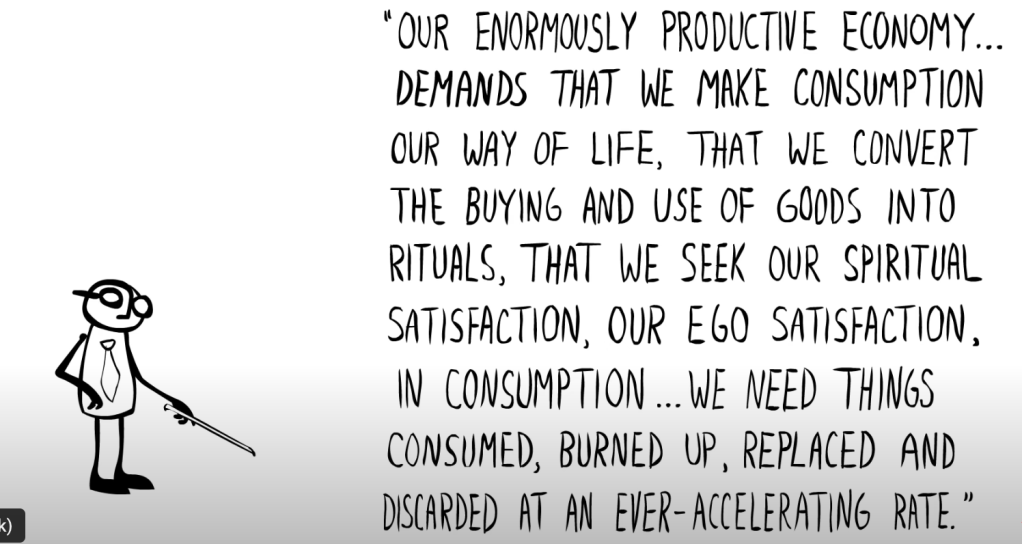
Victor Lebow quote taken from The Story of Stuff (Leonard, 2009, 12:03)
As ‘The Story of Stuff’ highlights, the extraction, production and disposal parts of our clothing lifecycle is out ”out of our field of vision” as consumers, we only see what is advertised to us, and that’s what needs to change.
There are plenty of people within the industry also want change. Along each part of the process there are pockets of people striving to do better, be better. From “saving forests” and “clean production” (Leonard, 2009, 19:17), there are people trying to intervene and address issues on a local level. And this is where we come back to the problem being too big to solve as an individual, but as collectives, change can be created.
I witnessed this small shift begin in the UK earlier this year. Temperley London (2023) in the summer announced :
“Clothes that transcend seasons. Creating moments that become memories. Originated in Somerset the Temperley way.
We are undergoing a significant change to the way we do business. From July 2023, we are ceasing all discounted promotions and off-season sales – an important move which reinforces our love of craftsmanship, commitment to responsibility and respect for a product that is treasured a lifetime.
Curated monthly drops from small artisan production runs will live alongside our Heritage and Archive collections, replacing the typical seasonal trading calendar. Not only will this give our talented team more creative liberation to design, it will honour the devoted and skilled hand-work that goes into producing our luxurious garments.”
@temperleylondon
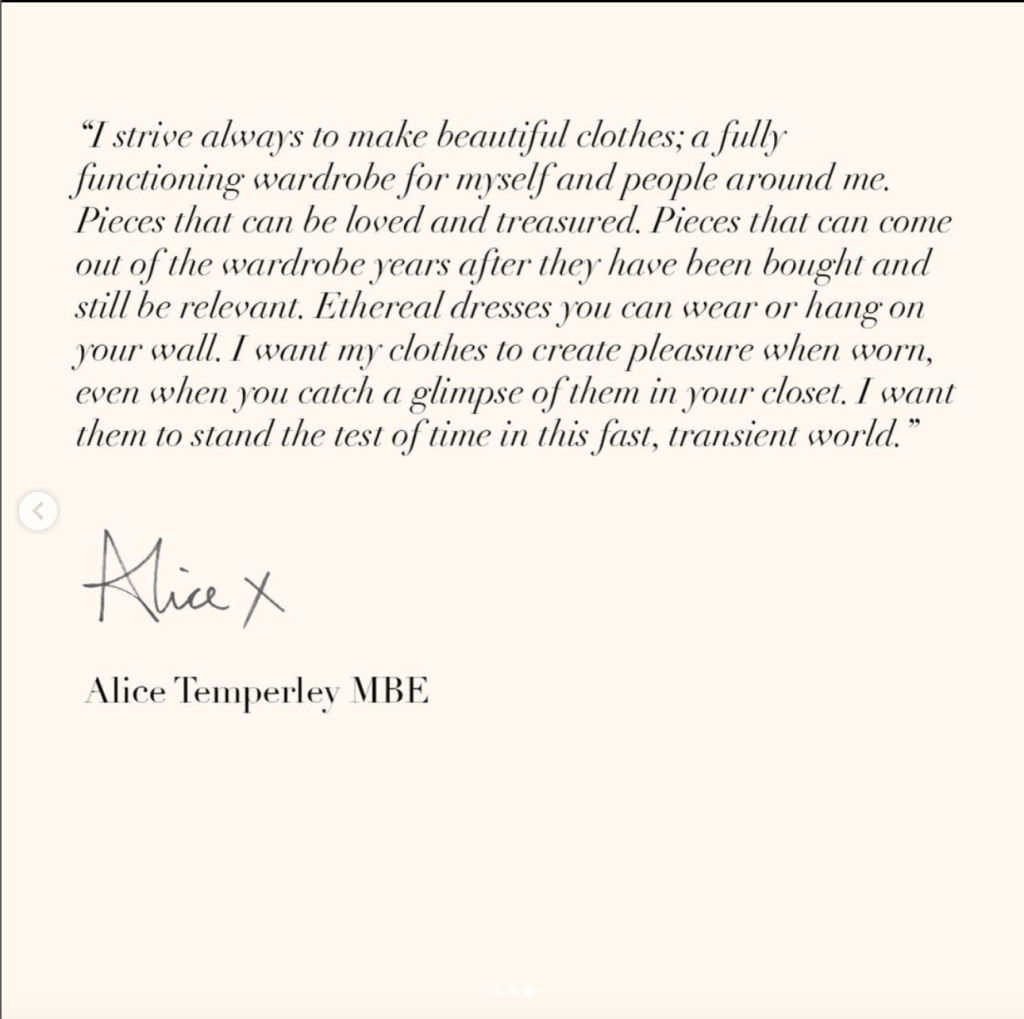
There are so many things to gain from removing the demands of S/S and A/W seasons and sales. We don’t require a whole new wardrobe because the temperature has shifted +/- degrees. And what happens if we charge the actual cost of a garment? Eradicate seasonal sales, the value of the item is the only price. Surely this will force retailers into conscious ordering if they are unable to discount old stock to shift remaining quantities? I’d love to see more brands follow Temperley Londons lead. If people are paying the true value of their clothing, then surely the consciousness comes back into buying? People being more selective over what garments they invest in and then look after them and cherish them, years to come.
Feature image : McCarty, AL. [@clotheshorsepodcast]. (2023, September 17). Why I talk about fast fashion. Instagram. https://www.instagram.com/p/CxRdKVwsnIJ/?img_index=1
References:
McCarty, AL. [@clotheshorsepodcast]. (2023, March 24). Let’s talk about how to spot fast fashion. Instagram. https://www.instagram.com/p/CqLE_PHuu-z/?img_index=1
Leonard, A. (2009, April 22). The Story of Stuff [Video]. YouTube. https://www.youtube.com/watch?v=9GorqroigqM.
Temperley London [@temperleylondon]. (2023, June 8). A message from Alice Temperley. Instagram. https://www.instagram.com/p/CtOXl1_M0aK/?img_index=1
 kellyfacekelly
Leave a comment