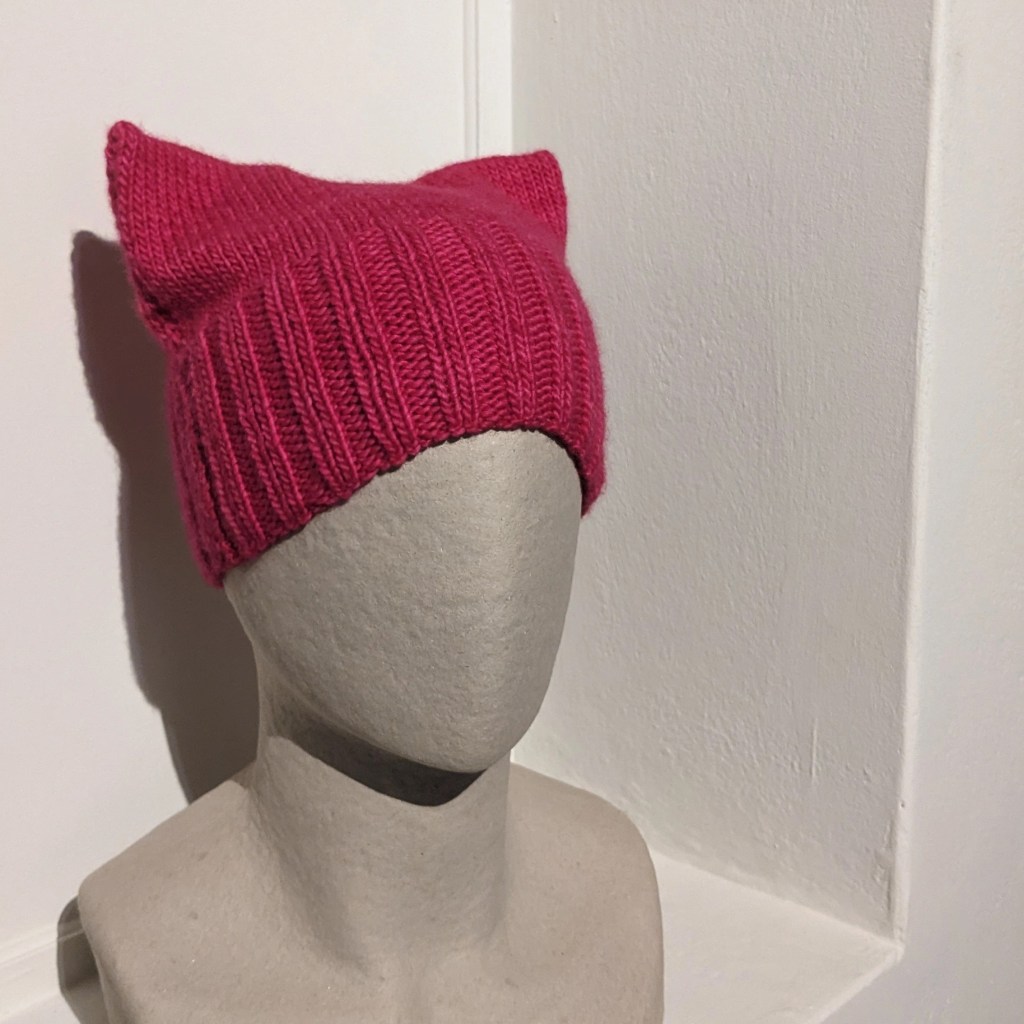
Using clothing to visually communicate and unite people is not a new concept. Textiles have been used this way for centuries.
“The mechanisation of textile industries from the mid-eighteenth century led to… increasingly affordable processes [that] ‘democratised’ textile decoration, allowing governments, regimes and corporations to harness the power of print to communicate, from wartime slogans to revolutionary ideals.” – The Fabric of Democracy (2023) The Fashion and Textiles Museum.
In wars, uniforms and flags are used to identify who you represent. The Suffragettes had their striped sashes. The Black Panthers sported their berets. Greenham Common Women’s Peace March hung their banners. In 2017, 500,000 Pussyhats ascended on Washington D.C. in opposition to Donald Trump and his ‘Make America Great Again’ campaign. Not forgetting (although rather forgettable as far as statement / impact goes) the HashtagMeToo Blackout at the Golden Globes and that is just a few examples of clothing being used to unite collective identities.
In recent years there are plenty of individuals who have used their platforms to highlight political and social issues. Beyoncės backing dancers in their berets (a nod to the Black Panther Party) at the Superbowl and Stormzy in his Banksy collab stab vest at Glastonbury highlighting knife crime in the UK.
Then you have the more, on the nose statements of Melania Trump in her “I don’t care, do you?” parker coat and Alexandria Oscario-Carter in her “Tax the rich” dress at the MET Gala.
Slogans on clothing are seen regularly fashion these days. Historically, prints and illustrations were popular ways to incorporate ideologies, but slogans became more popular in “the counterculture of the 1960’s and 70’s, when it was redolent of rebellion and protest movements, and was used to challenge the establishment”. The Fabric of Democracy (2023) The Fashion and Textiles Museum.
Having identified in my last post (Fast Fashion) the desire to shift behaviours and patterns in the fashion industry towards overconsumption and waste; I’d like to explore further how I can create, educate and communicate this concept using subversive techniques.
 kellyfacekelly
Leave a comment